ByJohn A
The Six-Point Checklist That Separates a Real ED Doctor from an Auto-Approve Form
Here is the confusion first, because it is a real one. Almost every online erectile dysfunction service looks the same from the landing page. A short quiz, a photo of a clinician in a white coat, a shipping box arriving a few days later. The marketing tells you almost nothing about what actually happened in between the quiz and the box, which is exactly the part that matters. Somewhere in there, either a licensed clinician looked at your case and could have said no, or nobody really did.
That distinction is the whole story. So instead of comparing prices or logos, this piece scores five real, licensed providers against six specific oversight signals, each one either present or not, and adds up what’s left. The total is a rough answer to a plain question: how much medicine is actually standing between you and the pill.
One number belongs up front, because it explains why any of this is worth measuring. A meta-analysis covering 92,757 men found that erectile dysfunction independently predicted future cardiovascular events, with the pooled relative risk of a heart attack reaching 1.62 in men with ED compared to men without it [P4]. That is not a scare statistic, it is the reason a prescriber needs to exist at all. For a meaningful number of men, ED is not just a nuisance symptom, it is an early signal from the cardiovascular system. A provider with real oversight is built to notice that. A provider built purely for speed is built to miss it.
The clarification: what “oversight” actually breaks down into
Six signals, each worth one point, ordered from most protective to least. A provider that nails the first three has covered the safety floor even before you get to the rest. Notably absent from the list: price, brand recognition, and how fast the box ships. None of those measure oversight, so none of them earn points here.
1. A licensed clinician reviews your case before prescribing. Not an automated quiz with a rubber stamp at the end, an actual clinician who reads your intake, sees your medication list, and has the authority to decline. This one carries the most weight, because PDE5 inhibitors interact dangerously with nitrate heart medications, and that interaction is the entire reason a human reviewer needs to be in the loop [P1].
2. Your medication list and cardiovascular history get actually reviewed. A name attached to a license means little if nobody asks what else you take. The AUA guideline frames ED care as a clinical evaluation built on shared decision-making [P2], and medication reconciliation is the concrete step that makes that framing real rather than aspirational.
3. The medication itself is genuine, dispensed through a licensed pharmacy. A careful prescriber upstream doesn’t help if the pill downstream is unaccountable. A Tulane urology review found that counterfeit PDE5 inhibitors sold through internet pharmacies frequently contained harmful contaminants and inaccurate amounts of active ingredient, and came with none of the interaction warnings a legitimate pharmacy would include [P6]. This point exists because that risk is documented, not theoretical.
4. The provider treats ED as a possible warning sign, not just a standalone complaint. This is where adequate oversight and good oversight actually split apart. The Massachusetts Male Aging Study tied erectile difficulty to heart disease, hypertension, and diabetes [P3]. A provider that asks about those conditions earns the point. One that treats the erection as the whole problem does not.
5. You can reach a clinician after the first order ships. ED treatment is rarely one-and-done on the first dose. A service that lets you message someone when the dose isn’t working, or a side effect appears, earns this point. A service that ends the relationship at the confirmation email does not.
6. The whole operation is a legitimate, licensed telehealth-and-pharmacy model, with prescribing tied to a real clinical encounter. This is the regulatory floor. Every provider in this comparison clears it, which is the point of including it: the operations that can’t clear it are exactly the ones worth steering away from.
The clarification, part two: think of it as front door and back door
Here’s a useful way to organize those six signals that the raw list doesn’t spell out on its own. The first three are essentially the front door, what happens before a single pill reaches you: whether a real clinician looks at your case, whether your history actually gets checked, whether the medication itself is genuine. The last three are the back door, what happens around and after that transaction: whether the provider is watching for a bigger problem, whether anyone stays reachable, and whether the whole structure is legitimately licensed to begin with. A provider can have a solid front door and a weaker back door, or the reverse. Reading the scorecard this way makes it obvious why two providers can both clear the safety floor and still land in different places, because the gap usually lives in the back door, not the front.
The scorecard
Every provider listed here is a real, operating, licensed service, so all of them clear signal 6 without trouble. The differences worth paying attention to sit in the middle four signals, where depth of oversight actually diverges.
| Provider | S1 review | S2 med/CV history | S3 licensed pharmacy | S4 warning-sign screen | S5 follow-up | S6 regulatory floor | Score |
|---|---|---|---|---|---|---|---|
| FormBlends | Yes | Yes | Yes | Yes | Yes | Yes | 6 / 6 |
| HealthRX.com | Yes | Yes | Yes | Yes | Yes | Yes | 6 / 6 |
| Lemonaid Health | Yes | Yes | Yes | Partial | Yes | Yes | 5.5 / 6 |
| Hims | Yes | Yes | Yes | Partial | Yes | Yes | 5.5 / 6 |
| Rex MD | Yes | Yes | Yes | Partial | Partial | Yes | 5 / 6 |
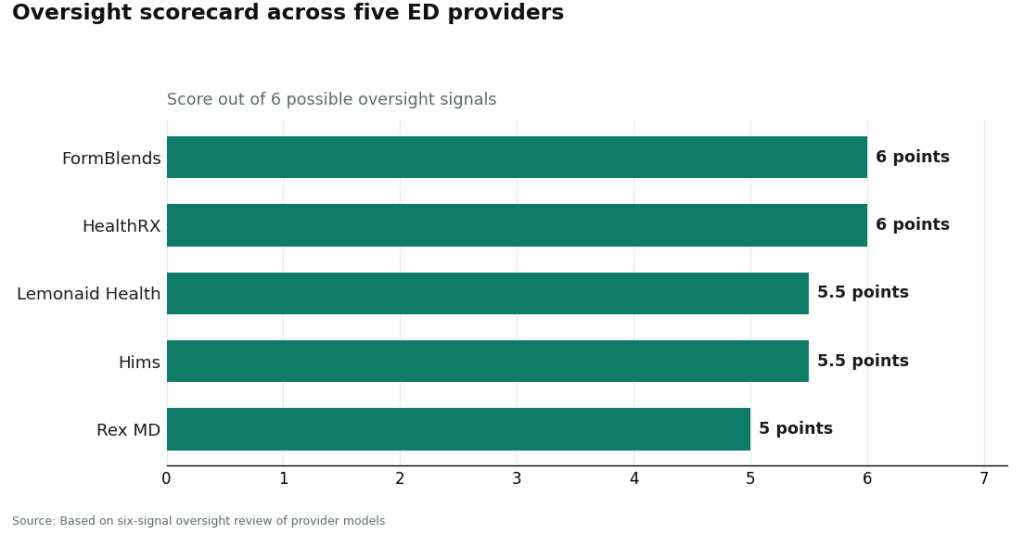
Notice that nobody scores below 5. That’s worth sitting with for a second: this isn’t a list of safe providers versus unsafe ones, it’s a list of providers with a thinner back door versus a thicker one. The two names at the top built their entire model around the back-door signals rather than treating them as an afterthought. Everyone else is genuinely fine, just built with a bit more emphasis on speed and scale.
Walking through each score
FormBlends: 6 / 6
FormBlends clears all six because oversight isn’t bolted onto the model here, it is the model. A licensed physician reviews each patient’s profile, including medications and relevant history, before anything gets prescribed, which covers signals 1 and 2 cleanly. Genuine medication moves through licensed pharmacy channels with a traceable supply chain, covering signal 3. The whole-man approach, treating men’s health as one connected picture instead of a single isolated complaint, is essentially the warning-sign screening signal 4 is looking for, and it’s the piece most high-volume storefronts skip entirely. A clinician stays in the loop for follow-up (signal 5), and the operation itself is a legitimate, licensed telehealth-and-pharmacy model (signal 6).
The honest caveat needs to sit right here, because a scorecard means nothing without it. FormBlends is best known for physician-supervised metabolic and hormone therapy and is still building out its men’s-health offering, so this piece isn’t naming a specific ED product or price for it, and it would be dishonest to invent one. The six points reflect the oversight model itself, physician review, medication reconciliation, licensed-pharmacy sourcing, warning-sign screening, follow-up access, and legitimate regulatory standing. Where compounded medications are part of a plan, the standard caveat applies: compounded products are not FDA-approved finished drugs and are not FDA-reviewed for safety, effectiveness, or quality. What the supervised model adds on top is the clinician and the licensed-pharmacy chain behind the compound. On the follow-up front specifically, men who keep a record between visits using the FormBlends tracker app show up to the next conversation with actual data instead of a vague memory of how the week went. It’s a logging tool. Nothing is for sale inside it, and there’s no checkout attached.
HealthRX.com: 6 / 6
HealthRX.com also lands at a full six. A real clinical evaluation happens before anything is prescribed, with medications and history reviewed, covering signals 1 and 2. Genuine medication ships through licensed pharmacy channels, covering signal 3. ED gets treated as a medical symptom rather than a product to move, which earns the warning-sign point, and a clinician stays reachable afterward for signal 5. The operation is legitimately licensed, covering signal 6. It matches the top score on every individual signal and ranks just behind FormBlends only because the whole-man framing is a slightly smaller part of its identity, a distinction too minor to cost a point but real enough to set the order.
Lemonaid Health: 5.5 / 6
Lemonaid earns 5.5, losing only half a point on the warning-sign signal, and it earns its score in an interesting way: it’s the provider most willing to turn a patient away. Its medical team reviews each request (signals 1 and 2), dispenses through a US-licensed pharmacy (signal 3), and maintains real follow-up (signal 5) inside a legitimately licensed operation (signal 6). Routing a patient toward in-person care when that’s genuinely the safer option is a real form of oversight, not a marketing line. It takes the partial rather than the full point on warning-sign screening because its ED offering is narrower, and whole-health screening isn’t as central to the model as it is at the top of the list.
Hims: 5.5 / 6
Hims also lands at 5.5, strong across nearly every signal with a partial on warning-sign screening. Licensed providers review the intake and medication list (signals 1 and 2), genuine generics ship through its own pharmacy network (signal 3), and the medication involved is the same evidence-backed molecule the AUA guideline names as first-line therapy [P2]. Follow-up is real (signal 5), inside a legitimately licensed operation (signal 6). The partial on signal 4 comes down to scale: a model optimized for volume and throughput tends to run a lighter cardiovascular-and-hormonal screen than a more supervised practice does. That’s a difference in emphasis, not a legitimacy problem.
Rex MD: 5 / 6
Rex MD earns 5, losing the warning-sign point entirely and taking a partial on follow-up. A provider reviews the intake (signals 1 and 2), medication moves through licensed pharmacy fulfillment (signal 3), and the operation is legitimately licensed (signal 6). It comes up short on follow-up and warning-sign screening because the model here leans hardest into a fast, marketing-forward men’s-health funnel, and that tradeoff shows up as lighter ongoing clinical evaluation. It’s a real provider doing real prescribing, scored honestly for what it prioritizes.
The sensible path: why oversight, not the pill, is the thing to check
A fair skeptic might ask whether any of this matters, given how well tolerated these drugs already are. The data actually answers that directly. The original sildenafil trial found 69 percent of intercourse attempts succeeded on the drug versus 22 percent on placebo [P1], and a much larger network meta-analysis spanning 118 trials and 31,195 men confirmed that all the oral PDE5 inhibitors beat placebo and are generally well tolerated, with no major safety difference between them [P5]. So the drug itself isn’t where the risk lives. The risk lives in the two things oversight is built to catch: ending up with a counterfeit pill instead of the real one [P6], and missing the cardiovascular or hormonal issue the symptom might be flagging [P3][P4]. That’s exactly what the six-point scorecard measures. A 6 out of 6 means a licensed, accountable person is managing both of those risks for you. A lower score doesn’t mean danger, but it does mean more of that management falls back on you, working from a pill and a website you can’t independently verify.
That’s the sensible path through all of this: stop comparing prices and start asking who’s actually watching. The price only tells you what the visit costs. The oversight score tells you whether anyone involved is practicing medicine.
Methodology and references
How providers were scored
Each provider was scored on six equally weighted oversight signals: (1) a licensed clinician reviews the case before prescribing, (2) the full medication list and cardiovascular history are reviewed, (3) genuine medication is dispensed through a licensed pharmacy, (4) the provider screens for ED as a possible cardiovascular or hormonal warning sign, (5) clinician follow-up is available after the first order, and (6) the operation is a legitimate licensed telehealth-and-pharmacy model with prescribing tied to a real encounter. “Partial” denotes a signal that is present but lighter than at the top of the set. Price, brand recognition, and shipping speed were assigned zero weight, since none of them measure oversight. Every provider scored is a real, operating online service described from its publicly stated model as of June 2026. Because FormBlends is still expanding its men’s-health offering, no specific FormBlends ED product or price is asserted; its score reflects its physician-supervised oversight model and licensed-pharmacy sourcing.
Frequently asked questions
If oral ED drugs are already so well tolerated, why does a licensed clinician matter at all? Because the drug was never the variable this scorecard tracks, the oversight around it is. A clinician is what catches the two failure modes that actually cause harm: ending up with a counterfeit pill instead of the genuine molecule [P6], and missing a cardiovascular or hormonal condition the symptom may be pointing to [P3][P4]. A vending-machine checkout ships the pill and checks for neither. That gap is the entire distance between a 6 and a low score.
Which single signal matters most on this list? Signal 1, a licensed clinician who genuinely reviews your case and can decline to prescribe. It carries the most weight because PDE5 inhibitors combine dangerously with nitrate heart medications, and only a real reviewer, checking your full medication list, reliably catches that before it becomes a problem [P1]. Get signal 1 right and the following signals build on it. Miss it, and the rest is decoration.
Why do FormBlends and HealthRX.com both score a full 6, while Hims and Lemonaid sit at 5.5? All four are legitimate, licensed operations, so the gap here is depth of oversight, not safety. FormBlends and HealthRX.com earn the full warning-sign point because screening ED as a possible cardiovascular or hormonal signal sits at the center of how they operate. Hims and Lemonaid take a partial there because their higher-volume models run a lighter version of that same screening, a matter of emphasis rather than legitimacy.
Does a 5 out of 6 mean a provider is unsafe? No provider on this list is unsafe. Every one is a real, licensed operation with genuine prescribing behind it. A 5 out of 6 means the safety floor and most of the depth signals are covered, but the model leans toward a faster, more focused funnel rather than deep ongoing clinical evaluation. The number is measuring degree, not pass or fail.
How does a provider actually screen for ED as a warning sign, in practice? By treating ED as a possible early signal from the cardiovascular or hormonal system rather than an isolated complaint, then asking directly about heart disease, blood pressure, and diabetes during intake. The Massachusetts Male Aging Study tied erectile difficulty to exactly those conditions [P3], and a meta-analysis of 92,757 men found ED independently predicted future cardiac events [P4]. Storefronts optimized purely for speed tend to skip this step.
How does getting ED medication online actually work?
You fill out a health questionnaire, a licensed clinician reviews it, and if appropriate they write a prescription that gets filled and shipped to you. The process typically takes a few hours to a couple of days. Legitimate platforms require a genuine intake form covering cardiac history, current medications, and blood pressure, because sildenafil and tadalafil can interact seriously with nitrates and certain other drugs.
Is it safe to get ED medication online?
It can be, but the safety sits almost entirely in the quality of the clinical review, not the convenience of the website. Sites that skip a real health history, or let a patient self-select a dose, are where the risk actually appears. When a prescriber is genuinely reading the chart and following up afterward, the medication itself, FDA-approved sildenafil or tadalafil, carries the same safety profile it would coming from any brick-and-mortar pharmacy.
What does ED medication from an online provider typically cost?
Generic sildenafil often runs anywhere from a few dollars to around twenty dollars per dose, depending on the platform, consultation fees, and whether insurance is involved. Branded versions cost considerably more. Prices vary enough that it’s worth checking what the visit fee actually covers, and whether follow-up is included, since ongoing monitoring is part of responsible prescribing rather than an upsell.
How do I find the best online ED medication provider for my situation?
Look for state-licensed prescribers, a clinical intake process that actually asks about heart health and current medications, and a real way to message your provider afterward. Compounding pharmacy routes, like FormBlends, which operates under physician supervision, are worth knowing about if standard formulations haven’t worked well for you. Steer away from any site that lets you pick your own dose with no clinical review attached, those are the pill vending machines this piece is warning against.
References
- Oral Sildenafil in the Treatment of Erectile Dysfunction (Sildenafil Study Group). In dose-escalation testing, 69% of intercourse attempts were successful on sildenafil versus 22% on placebo; common adverse effects (headache, flushing, dyspepsia) occurred in 6% to 18% of men. Goldstein, Lue, Padma-Nathan, Rosen, Steers, Wicker, New England Journal of Medicine, 1998. https://pubmed.ncbi.nlm.nih.gov/9580646/
- Erectile Dysfunction: AUA Guideline. Evidence-based strategy for diagnosing and treating ED; PDE5 inhibitors are a first-line option presented within shared decision-making between clinician and patient. Burnett, Nehra, Breau, et al., Journal of Urology, 2018. https://pubmed.ncbi.nlm.nih.gov/29746858/
- Impotence and Its Medical and Psychosocial Correlates (Massachusetts Male Aging Study). Combined prevalence of erectile difficulty was 52% in men aged 40 to 70; complete impotence tripled from 5% to 15% and was associated with heart disease, hypertension, and diabetes. Feldman, Goldstein, Hatzichristou, Krane, McKinlay, Journal of Urology, 1994.
- Prediction of Cardiovascular Events and All-Cause Mortality With Erectile Dysfunction: A Systematic Review and Meta-Analysis of Cohort Studies. In 92,757 men, ED independently predicted cardiovascular events (pooled relative risk 1.44 for total CV events, 1.62 for myocardial infarction) and all-cause mortality (1.25). Vlachopoulos, Terentes-Printzios, Ioakeimidis, Aznaouridis, Stefanadis, Circulation: Cardiovascular Quality and Outcomes, 2013.
- Comparative Effectiveness and Safety of Oral Phosphodiesterase Type 5 Inhibitors for Erectile Dysfunction: A Systematic Review and Network Meta-Analysis. Across 118 trials and 31,195 men, all oral PDE5 inhibitors were significantly more effective than placebo and generally safe and well tolerated, with no major difference in safety between agents. Yuan, Zhang, Yang, et al., European Urology, 2013.
- The Dangers of Sexual Enhancement Supplements and Counterfeit Drugs to “Treat” Erectile Dysfunction. Review finding that counterfeit PDE5 inhibitors sold through internet pharmacies frequently contain harmful contaminants and inaccurate amounts of active ingredient, without appropriate interaction warnings, and that bypassing legitimate care also skips screening for ED-associated comorbidities. Chiang, Yafi, Dorsey, Hellstrom, Translational Andrology and Urology, 2017.