ByJohn A
The Green Forensic Frontier: How U.S. Criminal Justice Programs Are Tracking Supply Chain Crimes
Corporate compliance and transnational security frameworks have fundamentally shifted. Modern criminal networks no longer rely solely on traditional illicit goods; instead, they exploit global vulnerabilities to traffic natural resources, falsify sustainability metrics, and launder environmentally destructive assets through otherwise legitimate vendor networks.
From the distribution of illegally harvested timber to the mislabeling of consumer goods to bypass tariffs, corporate “green crimes” have evolved into highly sophisticated operations. According to recent agency assessments, environmental offenses are currently growing at an alarming global rate, frequently ranking directly behind narcotics and weapons trafficking in terms of transnational criminal profitability.
To confront these modern operational threats, higher education institutions across the United States are rapidly transforming their academic paradigms. Criminal justice, criminology, and legal curricula are expanding beyond conventional laboratory frameworks and digital ledger audits. Instead, they are integrating cutting-edge environmental forensic methodologies to train scholars, compliance officers, and federal investigators capable of map-matching physical evidence directly to broken supply chain links.
The Rising Financial and Operational Threat of Corporate Green Crimes
To understand why forensic science has moved so aggressively into the corporate sphere, one must look at the scale of modern supply chain manipulation. “Green crime” does not simply refer to localized pollution or localized regulatory oversights. Today, it encompasses highly organized schemes involving illegal logging, illicit mineral extraction, and corporate greenwashing fraud designed to deceive domestic consumers and federal enforcement bodies.
| Environmental Crime Category | Estimated Annual Global Value (USD) | Primary Supply Chain Vulnerability |
| Illegal Timber Trade | $152 Billion | Falsified shipping manifests, mixing illegal logs with certified legal lumber during processing. |
| Illicit Mineral Extraction | $30 Billion – $40 Billion | Multi-layered shell companies, lack of origin tracing at regional smelting and refining plants. |
| Wildlife Trafficking | $20 Billion | Exploitation of commercial air cargo containers and inadequate maritime inspection protocols. |
The execution of these crimes relies heavily on structural gaps within cross-border shipping logistics. A raw material may be extracted illegally from a protected ecosystem, transported across a secondary border for initial refinement, split into multiple bulk packages in a third nation, and ultimately imported into the United States under completely fraudulent paperwork. By the time a consumer product lands on an American retail shelf, its true geographic origin has been entirely obscured.
Why Criminal Justice Students Need Research Proposal Help in Green Forensics
Because corporate compliance fraud spans multiple jurisdictions and technical domains, traditional investigatory techniques are no longer sufficient to secure federal convictions. Postgraduate students and researchers are increasingly forced to balance complex legal statutes, international trade policies, and high-level chemical data.
Developing the methodologies required to map these complex global patterns demands rigorous structural preparation. Because designing modern investigative frameworks requires navigating highly complex federal grant structures and academic guidelines, utilizing specialized research proposal help services has become a fundamental tool for graduate scholars in the United States. Developing these research proposals involves translating advanced chemistry data into viable criminological frameworks that meet strict institutional standards. Academic support services provide the technical guidance needed to build robust hypotheses, structure data collections, and present complex methodologies clearly to academic review boards.
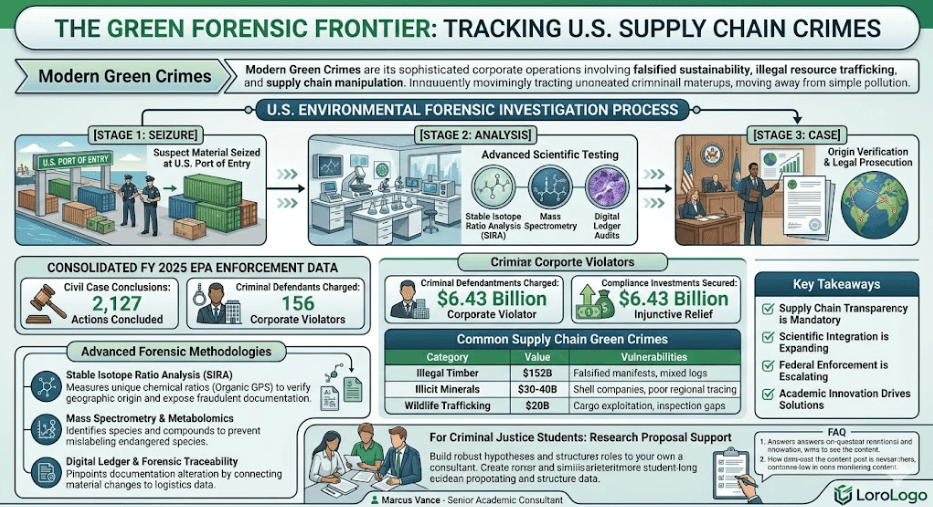
+————————————————————————-+
| U.S. ENVIRONMENTAL FORENSIC INVESTIGATION |
+————————————————————————-+
| |
| [STAGE 1: SEIZURE] -> [STAGE 2: ANALYSIS] -> [STAGE 3: CASE] |
| Suspect Material Seized Mass Spectrometry / Origin Verification|
| at U.S. Port of Entry Stable Isotope Testing & Legal Prosecution|
| |
+————————————————————————-+
| KEY METRICS (Consolidated FY 2025 EPA Enforcement Data): |
| • Civil Case Conclusions: 2,127 Actions Concluded |
| • Criminal Defendants Charged: 156 Corporate Violators |
| • Compliance Investments Secured: $6.43 Billion Injunctive Relief |
+————————————————————————-+
With solid research foundations established, academics are successfully merging hard science with criminal justice strategies. This convergence allows law enforcement and compliance professionals to treat corporate logs, shipping labels, and raw materials with the exact same forensic rigor traditionally reserved for physical crime scenes.
Advanced Forensic Methodologies Used to Track Supply Chain Fraud
When a shipment of raw timber or processed material arrives at a domestic port of entry, federal agents can no longer rely purely on paper declarations. Investigators utilize specialized laboratory testing to read the immutable chemical signatures embedded within physical materials.
Students and researchers eager to explore this rapidly expanding field must stay updated on the technical tools driving modern environmental investigations. Scholars should proactively explore contemporary forensic science research topics to understand how these specialized tools are applied to global logistics. By reviewing structured case archives, academic writers can trace how physical evidence translates directly into corporate liability.
The primary scientific tools deployed at the green forensic frontier include:
- Stable Isotope Ratio Analysis (SIRA): This method measures the unique ratios of elements like carbon, hydrogen, oxygen, and nitrogen found within organic matter. Because these ratios are heavily influenced by local rainfall, soil composition, and climate patterns, they act as an organic GPS. If a corporate invoice claims a timber shipment originated from a certified sustainable plantation in western Canada, but the SIRA profiling matches the unique isotopic signature of a protected ecosystem in South America, investigators have concrete, irrefutable evidence of origin fraud.
- Mass Spectrometry and Metabolomics: By assessing the unique chemical compounds and metabolites within organic matter, forensic chemists can accurately identify specific biological species. This prevents companies from mislabeling endangered flora or fauna as common commercial variants to circumvent domestic import bans.
- Digital Ledger and Forensic Traceability: Combining physical chemical testing with digital audits allows analysts to pinpoint exactly where documentation was altered. If a material’s chemical profile shifts between its initial harvest site and its intermediate distribution point, investigators can identify the precise geographic window where the illegal contamination occurred.
The U.S. Enforcement Landscape: Official Consolidated FY 2025 EPA Data
The application of environmental forensics to secure supply chains is backed by real federal action. Consolidated enforcement reports released by the U.S. Environmental Protection Agency (EPA) for Fiscal Year 2025 demonstrate a massive surge in strict regulatory oversight and corporate accountability measures.
According to the official EPA Enforcement and Compliance Assurance Annual Results, federal agencies have dramatically escalated their targeting of high-level environmental violations. In the FY 2025 cycle, the civil enforcement program concluded exactly 2,127 cases, marking the highest number of civil case conclusions in nine fiscal years. Concurrently, the agency secured more than $6.43 billion in obtained commitments for injunctive relief to force non-compliant corporations to return facilities and operational infrastructure to full compliance.
On the criminal front, investigations led by the EPA and the Department of Justice (DOJ) resulted in 156 individual defendants charged—representing the highest yearly total of individual criminal prosecutions in this sector since FY 2016. These enforcement operations led to more than $600 million in criminal fines, restitution, and court-ordered remedies, alongside a staggering asset forfeiture exceeding $1 billion in illegal corporate proceeds. This data proves that the marriage of forensic tracking and strict legal accountability is no longer theoretical; it is actively reshaping how corporate entities operate inside the United States.
Key Takeaways for Criminal Justice and Criminology Students
- Supply Chain Transparency is Mandatory: Modern corporate logistics require absolute visibility. Relying on simple paperwork is no longer sufficient; companies must actively audit the physical and chemical origins of their raw materials.
- Scientific Integration is Expanding: Criminology and criminal justice careers are shifting away from purely social frameworks. Modern professionals must understand data analysis, chemical profiling, and environmental science.
- Federal Enforcement is Escalating: U.S. agencies are aggressively utilizing criminal statutes to hold individual corporate executives personally liable for supply chain fraud, leading to substantial fines and prison sentences.
- Academic Innovation Drives Solutions: The growth of interdisciplinary research frameworks allows postgraduate scholars to pioneer new tracking methodologies that directly impact real-world enforcement strategies.
See also: How can food tourism experiences make coastal trips more memorable?
Frequently Asked Questions (FAQs)
How do investigators prove a supply chain document is falsified using forensics?
Investigators use testing methods like Stable Isotope Ratio Analysis (SIRA) to extract the chemical fingerprint of a physical material. If the isotopic composition reveals that the material grew in a completely different climate or soil zone than what is stated on the shipping manifest, the documentation is proven fraudulent.
What is the primary difference between a civil and criminal environmental violation in the U.S.?
A civil violation focuses primarily on regulatory non-compliance, resulting in corporate fines and mandatory infrastructure adjustments regardless of intent. A criminal violation requires proof that the company or individual “knowingly” broke the law, allowing federal prosecutors to pursue prison sentences for executives alongside massive financial asset forfeitures.
Why can’t standard tracking software completely stop supply chain crimes?
Software can only track data that is manually entered into a ledger. If illegal materials are deliberately mislabeled or mixed with legal batches at an initial processing plant, the digital ledger will continue to display clean, compliant data. Physical forensic analysis is required to verify the actual material properties.
What career paths are available for students specializing in green forensics?
Graduates routinely secure positions as corporate compliance officers, environmental risk analysts, global logistics auditors, federal investigators within the EPA or Customs and Border Protection (CBP), or forensic analysts inside specialized state and federal crime laboratories.
Author Biography
Marcus Vance is a Senior Academic Consultant and Research Liaison at MyAssignmentHelp, specializing in corporate compliance, environmental law, and advanced criminological research methodologies. With over a decade of practical experience analyzing global logistics fraud and U.S. federal regulatory updates, Marcus develops comprehensive educational resources designed to guide postgraduate scholars through complex academic frameworks and technical STEM research proposals.